


How To Obtain A Court Marriage Certificate In India? – A Simple, Real-Life Style Guide

Rahul and Aisha have been together for three years. Their families come from different communities, but they want to marry legally, peacefully, and with full protection of the law. One evening, while discussing their plans, they realised—they needed a court marriage certificate.
Like thousands of couples in India, they began searching:
“How to get a court marriage certificate?”
If you are also looking for the same answer, this story-like guide will help you understand the exact process, laws, documents, and Supreme Court judgments—all in simple language.
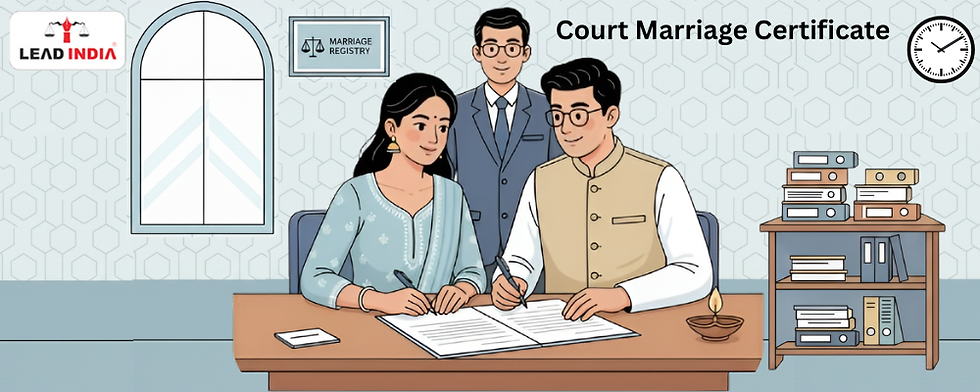
Why Is a Court Marriage Certificate Important?
A marriage certificate is not just a piece of paper. It is legal proof that two people are married. You need it for:
Passport and visa
Joint bank accounts
Buying property
Insurance and inheritance
Protection from family interference
Claiming maintenance or rights in future
The Supreme Court in Seema v. Ashwani Kumar (2006) said that registration of every marriage is compulsory because it protects women and helps avoid disputes.
Which Law Allows Court Marriage?
Court marriage happens under the Special Marriage Act, 1954. This law is made for couples of any religion, caste, or background.
Important sections:
Section 4 – Conditions to marry (age, consent, no prohibited relations)
Section 5 – Notice of intended marriage
Section 7 – Objections
Section 11–14 – Signing and solemnization
Section 15 – Issuance of marriage certificate
If a couple has already married traditionally (like pheras), they can register the marriage under Section 8 of the Hindu Marriage Act, 1955.
Important Supreme Court Judgments Supporting Court Marriage
1. Lata Singh v. State of UP (2006)
SC said that two adults have the full freedom to marry anyone they choose. No family member can interfere.
2. Shafin Jahan v. Ashokan (Hadiya Case, 2018)
SC said the right to choose a life partner is a part of Article 21 – Right to Life.
3. Seema v. Ashwani Kumar (2006)
SC made marriage registration compulsory for all communities.
These judgments protect couples like Rahul and Aisha who choose court marriage.
Documents Needed for Court Marriage Certificate
Rahul and Aisha prepared these documents:
ID & Age Proof (Any one)
Aadhaar, PAN, Passport, Driving Licence
Address Proof (Any one)
Voter ID, Utility Bill, Rent Agreement, Passport
Other Documents
6 photos each
Affidavits stating date of birth, marital status, and nationality
Divorce decree or death certificate (if applicable)
NOC from the embassy (if one partner is a foreign citizen)
Having these documents ready makes the process smooth.
Step-by-Step Process – Explained Like a Simple Story
Step 1: Filing the Notice
Rahul lived in Delhi for more than 30 days. So they visited the Marriage Registrar’s office near his address.
They filled a form called Notice of Intended Marriage (Section 5, SMA).
The officer displayed this notice on the office board for 30 days—this is the rule across India.
Step 2: Waiting Period of 30 Days
During these 30 days, anyone can raise an objection.
But objections must be legal—like age, prohibited relationship—not “different caste” or “different religion”.
As the Supreme Court said in Lata Singh, caste or religion cannot stop adults from marrying.
No objection came in Rahul and Aisha’s case.
Step 3: Appearing Before the Registrar
After 30 days, they visited the registrar again with three witnesses.
Witnesses can be friends, relatives, or colleagues.
They all signed a simple declaration under Section 11 confirming they were marrying with free consent.
Step 4: Marriage is solemnised
There is no ritual needed.
They just signed in front of the officer and witnesses.
Under Sections 13 & 14, the officer completes the formal solemnization.
Step 5: Certificate Issued – The Most Important Step
The Marriage Officer entered their details in the official Marriage Register.
Under Section 15, they received their Court Marriage Certificate.
This certificate is accepted everywhere—passport office, visa, banks, and courts.
To Rahul and Aisha, it felt like a new beginning.
If You Are Already Married Traditionally
If a couple has already performed rituals, they don’t need the 30-day notice.
They can directly register the marriage under the Hindu Marriage Act, 1955 (Section 8).
They simply go to the registrar with:
Wedding photos
Priest certificate
Affidavits
Age & address proofs
A certificate is usually given within 1–7 days.
What Is the Time Required?
Court Marriage (SMA) → 30 days + 1–3 days for certificate
Traditional Marriage Registration → 1–7 days
What Are the Fees?
Government fees usually range between ₹100 to ₹1,000, depending on the state.
Final Thoughts
Court marriage is one of the easiest and safest ways for two adults to legally register their relationship in India. The process is transparent, protected by strong laws, and supported by clear Supreme Court judgments.
Couples like Rahul and Aisha often feel nervous in the beginning, but once the certificate is issued, they gain full legal rights and protection.
FAQs
1. Can I get a court marriage without telling my parents?
Yes. The Supreme Court in the Lata Singh and Hadiya case said adults have the freedom to choose their partner without parental permission.
2. Can we download the marriage certificate online?
Many states, like Delhi, Maharashtra, Uttar Pradesh, and Rajasthan, offer online downloads after registration, depending on the portal.
3. Can a foreign citizen do a court marriage in India?
Yes. Under the Special Marriage Act, they can. They need a passport, a visa, address proof, and an NOC from their embassy.
Watch Also:
Court Marriage Latest Update December 2025👫😱। दिसंबर 2025 में कोर्ट मैरिज में बड़ा बदलाव ज़रूर देखें


Comments